Let's Promote Libraries!

by Brooke King, Middle School Librarian in Humble ISD, TxASLTalks Editorial Board

As school librarians, we need to do a better job of promoting ourselves and all the amazing happenings in our libraries. Many stakeholders may not fully understand all that we do. The TxASL Legislative & Advocacy Committee wants to change that.


The Let’s Promote Libraries initiative is a monthly social media campaign to encourage school librarians to promote themselves, their programs, and their instruction. It is organized around the revised standards and each month’s topic is framed as a question. We might ask, “Did you know school librarians train staff?” or “Did you know we celebrate diversity in all its forms?”


On the 17th of each month, we’re asking school librarians to send a social media message about what we do. You can post on any social media outlet or even send an email to a stakeholder. We want to focus on local stakeholders first, and then at the state and national levels.


It’s easy to participate!
Step 1: Look at the current month’s question.
Step 2: Snap a photo and write your message.
Step 3: Post your message and photo on any/all platforms of social media.
Step 4: Be sure to use the hashtag #txaslleg along with other key hashtags. Step 5: Repost/retweet/share


How Principals can Support Libraries

This entry was written by Lucy Podmore, High School librarian in Northside ISD, San Antonio and TxASLTalks co-editor.
Outstanding NISD principals and library supporters,
Eric Tobias, Tracy Wernli, and Dr. Jerry Woods.
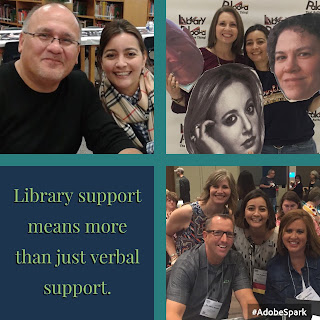
Ask any school principal in Texas if they support school libraries and I’d be willing to bet they would all say, “YES, 100%!”.  I believe it’s the follow up question, “ what does that support look like?” that may trip up some principals.  I have been fortunate in my career as a librarian to be in schools where that support is not only verbalized, but demonstrated.  As I reflect on my time in three school libraries, I noticed the strength of the library program was directly impacted by the kind of support I had with each of the principals.  The most successful programs enjoyed principal support in the following ways:

Inclusion on campus leadership team: The principals I’ve worked with have shown their support of the library program by welcoming me onto their campus leadership teams.  This is not only an invitation, but an expectation that I would actively participate in the discussions these campus leaders were having.  The opportunity allows me to hear the campus issues and department objectives of campus leaders so that I may then offer library resources or guidance to help them achieve their goals. Oftentimes it opens the eyes of many campus leaders to the notion that the library’s reach extends far beyond the physical space of the library.  Without a doubt, these meetings help me define my own goals for the library program throughout the year.  


Staffing support: In 2010 the State of Texas drastically reduced school funding and as a result, numerous positions across my school district were eliminated including library assistants.  At that time I was serving in a very active library with close to 1,400 students and I was devastated to know my ability to properly serve the students and staff would be significantly affected by this move.  My principal at that time helped me launch an active volunteer base who assisted with the numerous clerical duties of running a library, while I continued to focus on the instructional side.  A few weeks into the school year at my high school library, the principal  recognized the number of students visiting the library before school was consistently well over 200.  In recognition of the need for assistance, he reorganized the morning duty schedule to include a library station.  Both of these examples of staffing support not only helped me with additional hands and eyes in the library, it also provided more advocates for both of those library programs.  I now had parents and teachers talking about the popularity of the library and the numerous resources and programs available. It is important to note that these changes and actions came about because these principals were frequent visitors to the library. They personally saw that assistance was needed and did what they could to provide it.  Administrators view things through their own special lens and consider solutions based on resources of which librarians may not be aware. An open invitation for administrators to spend time in the library is always a good practice.


Open Communication: Librarians and administrators share a common goal of helping students and staff succeed. When ideas are created on how to achieve those goals, it’s impossible for one person to understand various perspectives to attain that goal without communication. The most successful principals I have worked with have been great at giving me time to share ideas and plans with them. This time and open dialogue provides an opportunity to strengthen ideas by looking at multiple viewpoints.  I believe these principals understand the campus wide impact the library can have and saw the benefits of taking the time to ensure the success of various programs by looking at them with critical, yet supportive, eyes.  To be able to have those frank conversations is something that needs time to develop.  I am so thankful the principals with whom I have worked have allowed me the freedom to try new ideas with the knowledge that they supported my efforts and would be there to provide valuable insight to improve upon those ideas.


Staff Development Support: Being a school librarian can sometimes be a lonely position. There is no one else on campus who can truly understand and relate to the various issues we tackle daily.  Attending district, regional, state, or national/international conferences designed specifically for librarians is an opportunity to hear and learn from librarians outside the school district about their successful campus strategies and also helps us build our own PLCs.   I have enjoyed the support of principals who have generously paid for registration fees, assisted with accommodations during out of town events, and/or treated the absence as a "excused school business" absence.  In return for that support, I have always made it a personal expectation to share with staff and students the new information I learned while attending these events.  My principals have provided opportunities for me to develop and present staff development for staff showcasing library resources, technology instruction, and teaching ideas which helps me gain additional access to teachers. There are some teachers who may see the library and librarians as resources specific to certain content areas. Being in front of the entire faculty helps me demonstrate tools, ideas, and resources that are useful for all educators and helps build more relationships with my campus colleagues. By broadening my target audience beyond students and specific content areas, I am able to help even more students and educators.

I know being a principal is an exhausting job with multiple focal points. To run a successful school and library program, you need to create a team of hard-working people committed to your vision. I've been fortunate these principals have recognized me and the library program as valuable members of their team. The librarian can be a powerful partner in building a successful school, but we need principals who are willing to allow that partnership to blossom as well as librarians who are eager to accept the demands of such a partnership.

What does support look like on your campus? Are there areas in which you could develop a stronger partnership? What has been an effective way for you to gain additional support from your principal?

Happy August! Welcome to a new year with TxASL Talks.

Happy August Everyone!
Welcome to a new year of the TxASL Talk blog.  We are excited to be joining you for a new year of sharing stories, information, and advocacy tips.  This year there are some changes coming to the TxASL Talk blog.  Since the TxASL Talks blog began in 2014 it has be run single-handedly by Dorcas Hand.  This year though, Dorcas will have an editorial board to help her.  The members of the editorial board include:


Dorcas Hand is a retired librarian of 38 years at all K-12 levels, 26 at her last school - plus 3 years as an elementary classroom teacher. Currently she works in advocacy efforts for AASL and TASL. As co-chair of the TASL Legislative and Advocacy Committee in 2014, she began to plan this TASLTalks blog which she has been editing ever since; she is thrilled to have an Editorial Team to join her now. She also co-leads Students Need Libraries in HISD, working to raise awareness on the HISD school board of what librarians could do for district student achievement. Check out her SNL Facebook page as well. Her personal advocacy website is StrongSchoolLibraries, and her Twitter handle is @handdtx.


Lucy Podmore is a high school librarian at Tom C. Clark High School in Northside ISD in San Antonio.  She is currently serving as secretary for TASL and has formerly served on the LoneStar Committee as both a reading member and administrative assistant. Lucy has presented at various district, state and national conferences on library tools and roles. She was named as TCEA’s Library Media Specialist of the Year for 2014-15. You can find Lucy on Twitter at @lupodmore where she co-moderates the Tuesday night Texas library chat #txlchat at 8pm central.


Sonja Schulz is a high school librarian at Nacogdoches High School in beautiful Nacogdoches, Texas. She is currently YART Councilor and Co-Chair for the Texas State Library Standards Revision Committee.  She has formerly served on many TLA committees, including the Lone Star Committee and the Spirit of Texas Middle School Committee, as well as serving as Secretary for District 8 and TASL Resolutions committee as both a member and Chair. She has presented at various district and state conferences on all things librarian and she is one of the moderators for the weekly librarian Twitter chat #txlchat.  You can find Sonja on Twitter @sonjaschulz.


Jacqueline Higginbotham is currently the media specialist at White Oak Middle School in New Caney ISD. She is the Incoming Chair for TALL Texans Round Table and serves on the TASL Legislative and Advocacy Committee. Jacqueline has been working in education since 2000 (and as a librarian since 2006) and is passionate about libraries and literacy. She knows that having a certified librarian on campus will lead to creating more lifelong readers, 21st century learners, and higher student achievement. You can find Jacqueline on Twitter @jhigg38.


Brooke King is the librarian at Atascocita Middle School in Humble ISD. She has been a librarian since 2008 and was an elementary language arts teacher for seven years before moving into the library. She is currently serving on the TASL Legislative and Advocacy Committee. Previously, she served as the webmaster/social media chair for the Texas Bluebonnet Award Program Committee. She has presented at local and state conferences on library programming. Brooke is a YA bookworm, library advocate, technology integrator, and passionate about personalized learning. Find her on Twitter @bookwormbrookek


Dr. Rebecca Novotny is currently the librarian at Hopper Middle School in the Cypress-Fairbanks ISD.  She has been a librarian for 10 years and before that she was a middle school English Language Arts teacher.  She is currently a Lead Middle School Librarian for the district.  She also is a Lead Librarian Mentor and participates on the district Destiny Training Team.  She has just completed her dissertation and has graduated with her Doctorate of Educational Leadership from Sam Houston State University.  You can follow her on twitter at @msrnovotny.


Some other changes will include a renewed focus on advocacy for school librarians.  This year at the end of each post, there will be tips to help you incorporate advocacy into your practice.  We know that advocacy for our programs and professions is important, and we want to give you tools that will help you be the best advocate and leader that you can be.  We will also be grouping the blog posts into themes.  The themes will include:
-Campus and Good news
-Targeted Advocacy (Campus Admin, District Admin, School Board, and/or Elected Officials)
-Instructional Ideas
-Collaboration Ideas
-Legislative Information and/or Updates


This blog is for you and we want you to be a part of it.  We would love to hear your ideas for blog posts, who you would like to hear from, and what information you find most helpful.  As well as advocacy tips and probing questions with each of the blog posts, there will be a chance for you to comment.  We would like you to write posts for the blog as well.  Here is a link for the TxASL Talks Blog Submission form: http://tinyurl.com/TxASLTalks-submission   
We have created a set of guidelines for blog posts.  
Blog Guidelines:

-500-800 words long
-include a picture/graphic
-Ensure your article addresses one of the following topics:
  • Campus and Good news (Have you or your library been recognized? Have you been awarded a grant? Has an initiative been wildly successful?)
  • Targeted Advocacy (what ideas do you have or have used successfully to advocate your library to specific stakeholders: legislators, board members, principals, parents, teachers, students?)
  • Instructional/Programming ideas
  • Collaboration ideas (think campus based or community based)
  • Legislative information or updates

Everyone on the TxASL Talks blog editorial board is excited for the year and we hope that you like the changes that are coming to the blog.  We cannot wait for you to join us on this journey and we cannot wait to hear from you.


What topics would you like to see us discuss, even if you aren’t ready to write the post yourself?