Showing posts with label professional learning. Show all posts

Podcasting in the Library and Amplifying Student Voice

By Alexandra Cornejo

Alexandra Cornejo is a high school librarian in Harlingen, TX. She is a member of the Texas Maverick Reading List Committee and hosts a booktalk podcast Allie the Librarian Booktalks. She is an enthusiast of comics and graphic novels and can often be found reading them late into the night with her booklight. Twitter @allie_cornejo


iPod + Broadcast =Podcast, this was the concept that was born in 2004 to offer the world radio on demand. Podcasts are usually audio only and meant for entertainment or news, but have since evolved to provide content on a multitude of subjects. There are actually about 750,000 podcasts or 30 million episodes available today!  It's not surprising that educators have found their niche within the podcast sphere and some of my absolute favorite podcasts are Cult of Pedagogy, Overthrowing Education and Educhange. However, my love of podcasts doesn’t stem from listening to them or even hosting my own. I really knew I loved podcasts when I realized they were an essential tool for providing students choice in the classroom or library. 

I've been listening to podcasts for years and I've always preferred them over YouTube or even music on the radio. Being an auditory learner, listening to thoughtful conversation has always aided in my comprehension of information. This served as an inspiration to bring this way of learning into the library; an innovative way for students to demonstrate evidence of learning or using it as a method of internalizing information. Choice boards have become popular and education technology is now essential to a quality education, so my hunt for a user-friendly way of recording a podcast was urgent. I needed an app that wouldn’t be hard for students to grasp and made the product easily shareable. Synth was an app I found on library Twitter that offered everything I needed to carry out podcasting for the classroom. Synth, at the time, allowed 4 ½ minutes to record and students could respond to their classmate’s podcast through voice comments. I immediately brought it into my library and had students begin creating their own podcasts by summarizing informational texts and having their classmates, or audience, respond with thoughtful commentary. Podcast projects grew to include reflections for expository writing, book reviews, interviews and eventually, even my Tech Team had a weekly podcast they were publishing. Podcast presentations became a fixture on my student choice boards and after I conducted podcast PD with my teachers, this presentation method was a common tool in my teachers’ digital toolbox. 

The benefits I’ve seen from podcasting with students have been numerous, indeed. Podcasts are immersive, which appeals to our sociologically trained ear that is inclined to listen to a story from start to finish, which also diminishes opportunity for distraction. Students develop valuable skills in articulating their thoughts effectively with the limited time they are allowed. Also, my students are their own harshest critics, so when they listen to themselves, they notice every “Um”, “Well”, and “Like” and quickly make the necessary adjustments. One of my favorite benefits, though, has to do with Emergent Bilinguals and the fact that they’re using their listening, speaking, reading and writing skills required for language proficiency when a podcast project requires script writing, voice recording and audience participation. And while Synth is still my preferred way of producing podcasts in the library, the trend has grown and increased in availability on a number of platforms, including Flipgrid, Garageband and Anchor. 

It’s a joy to witness my students become expert storytellers and savvy debaters, and I have, especially, enjoyed being able to effectively communicate with parents and teachers through an audio newsletter podcast I embed on my website. Podcasting has become such a passion of mine that I created my own podcast, Allie the Librarian Booktalks, which is available where you listen to your favorite podcasts. Conveniently, recording a podcast is fairly easy to carry out using a variety of devices. Chromebooks, laptops, iPads and smartphones are all great choices for recording. Earbuds with mic capabilities eliminate a lot of noise pollution which increases sound quality but are not necessary. 

I do hope you’ll give this a try in your library, as many of our students tend to be anxious creating a video response in class. Let podcasts serve as a way of easing a student out of their comfort zone to create something just as effective and entertaining. This is a trend that will not be going away anytime soon and I’m positive that it has found a permanent spot on our choice boards to amplify student voice.


Advocacy Doesn’t Stop When Retirement Begins


Jennifer Rike, Retired Librarian

In May 2020, I retired from my high school library position and have spent the past school year trying to figure out how to be retired.    During COVID, I stayed in touch with former colleagues, and realized my former peers were experiencing a hard time.  It wasn’t just Covid struggles, this went beyond that.  One friend could not even talk about it.  But sometimes, your gut just tells you to reach out to someone.  I’m so glad I did.

We began with a conversation about the past year.   But then came a shocker.  My friend mentioned that in April all elementary principals had been told it would be “okay” to put all their librarians in rotation.  My friend’s principal was going to follow that advice.  Sadly, the elementary librarians in my former district had no advocate at the district level.  My school district of 49 schools doesn’t have a library director.  And the person who had suggested rotation?  Their district level advocate.  


My anger and frustration at the situation forced me to step up.  This was a Thursday afternoon and the next school board meeting was the following Tuesday.  So there were about four days to pull together some sort of presentation for the board.  


So just how do you advocate when you are retired?  First, I recruited some other district retiree friends.  This allowed me to build a “brain hive”.  Secondly, I reached out to library administrators I had worked with through TLA and in advocacy work over the years.  This not-so-subtle plug reminds us of why we need to work with our professional organizations.   The Texas Library Association has been a large part of my professional development and advocacy training.  


The TLA hive was powerful as I prepared my presentation. My local hive helped craft and deliver the message.


The benefits of the hive included:

1. Help researching talking points 

2. Curating links to documents.

2. Perspective in what would resonate with the school board.

3. Valuable suggestions to improve my presentation.


The most valuable suggestion was never, ever surprise your superintendent.  Send an email with your intent to speak at the board meeting.


 Besides not surprising the superintendent, it gave her an opportunity to have an Area Superintendent and the Directors of Elementary Education to call me.  This allowed for a conversation.  While not extensive, it was a start.  


Next, I constructed 3 focused questions for the school board.  Then I sent an email to my school board with these questions.  This variation of the one sent to the superintendent shifted the focus to the board as the audience.  It also allowed for continuity of thought.  By sending the board an email prior to their meeting allowed them to “listen” more critically.  It also allowed me to provide resources for the board to review both prior to and after my presentation.


Lastly, another retired librarian and I spoke at the school board meeting.  We prepped dividing the information so we maximized our 3 minute speaking time.  We distributed to the school board, superintendent, top administrators copies of the advocacy piece created by Dorcas Hand.  I sent a follow-up email thanking everyone for the opportunity to speak.


How effective was this advocacy work?  One of the school board members spoke to the superintendent the next day for 30 minutes. Later, two additional school board members thanked me for letting them know what was going on.  Will that result in keeping the librarians from going into rotation?  I hope so.  


More importantly, I know that advocacy works.  Our school board and administrators know there are people in the community who are interested and knowledgeable about how librarians benefit learning and student outcomes.  And I have built a “hive” of support for the future.


My advice for current librarians includes:  

  • Reach out to the TLA advocacy folks when you need them.  Ask them to become advocates or recommend options.  

  • Cultivate your retired peers.  The more members of your hive you have, the better your response to the issue.  We care and there are no consequences to our job.  This is one perk of retirement.  

  • Reach out to parents.  

  • Lastly, remember you are not alone.  The phrase “the hive is powerful” is true.  


Together the hive can create a voice of advocacy.  Start building your hive today so it can spring into action when needed.  


Editor’s note:  As a District Level Supervisor I can attest that while district leadership will speak on your behalf, parents, retired librarians, and others speaking up through emails, petitions, and talking to Principals, Administrators, and School Board Members is more powerful.  Look to district leadership to provide guidance and help with statistics.  


Looking Ahead: Words from Texas Association of School Librarians Chair 2021-22

by Jill Bellomy, TASL Chair 2021-22, Librarian, Highland Park Middle School Library and Lead Librarian, Highland Park ISD

TASL

We did it! We made it to the summer after one incredibly trying school year. Last August, did you wonder how we would make it through the first semester yet alone the year? I certainly did. Yet here we are! Throughout the months, we were challenged and stretched. We learned and grew. We creatively met the needs of our students and staff in brand new ways. We served as technology troubleshooters daily. We helped teachers discover different ways to engage students in person and online. We ran our homes while also focusing on the needs of our schools. We kept kids reading and learning. We have so much to be proud of, school librarians!

That said, our experiences looked very different from school to school. Many of us could perform the essential functions of a circulating library, but not much else. Some operated full curbside service to get books to large numbers of remote learners. Others could not even circulate materials as administrators called us to serve other duties. Some welcomed students back into their spaces, and others were never able to do so. Most felt they existed in survival mode, facing challenge after challenge and just trying to get to the finish line.

Whatever your situation, TASL recognizes that you endured a year like no other. We want to support you as you look ahead. We hope to help all our members take the necessary steps toward running engaging library programs that are again the hub of the school. To move from surviving to thriving!

TASL will continue to strive toward our mission of promoting library services and librarianship in Texas school libraries. We will pursue that in many ways that include connection, advocacy, and professional development. These are more important now than ever!

CONNECTION.

We encourage you to reconnect with colleagues in your area and across the state to form and grow your PLNs.

  • Thank you to the many members who volunteered for TASL Committees!
    You will form new connections and will help us do the vital work of the division. If you missed the chance to volunteer this time, watch for another opportunity to assist in the spring.
  • To stay up on the latest, be sure to follow @TxASL on Twitter (if you aren’t already.) Heather Hornor and our exceptional Social Media Team
    keep us in the know, and the TASL members are constantly posting innovative ideas. So follow for inspiration and new connections!
  • Watch for an exciting new online community coming soon to TLA. This community will replace the listservs and will allow members to engage in more dynamic, meaningful conversation. Some TLA members are beta testing the platform this week, and it looks very promising.

ADVOCACY. 


TASL continually promotes librarians as valued teachers and leaders on our campuses, advocates for strong school libraries at the state level, and fosters advocacy skills in our membership.

  • You will find advocacy resources curated for you on the TASL website. Bookmark these to help you stay proactive in your efforts!

  • Brooke King and the TASL Legislative and Advocacy Committee do an excellent job of providing additional resources throughout the year. For example, last year’s School Library Bingo was fun and effective.

  • One meaningful way we advocate each year is by presenting and exhibiting at the PTA Launch Annual Conference. This year’s conference is July 30 - August 1 at The Gaylord Texan, Grapevine. Watch for a chance to sign up to work a shift (or two!) at the TASL booth. Serving at this conference is a great way to champion school libraries and to sharpen your advocacy skills!


PROFESSIONAL DEVELOPMENT. 


We provide professional learning at conference and throughout the year to help our members grow in the many roles we play in our schools.
  • We are already hard at work planning for TLA Annual Conference 2022! This year’s theme is perfect: Recover. Rebalance. Reconnect. Start making plans to attend April 25-28 in Fort Worth in person, if you can!
  • Thank you to all who submitted proposals.  There are many innovative submissions!  We will be in touch as we evaluate the submissions and select the best learning opportunities for our members. 
  • Watch for more learning offerings from Lakeisha Branch and the TASL Membership Committee in the months to come.

Echoing the sentiments of our TLA President Dan Burgard, it is now time to take a much-needed breath. You deserve some self-care after serving so many for so long. Rest, recharge and reflect over the upcoming weeks. If you think of ways TASL can help you or have ideas to strengthen our division, please share at https://bit.ly/TASLfeedback or reach out to me at jillbellomy at gmail dot com.


This year, we rose to the challenge before us, gathered strength and knowledge from each other, and persevered. Now, we can take the lessons learned and move forward stronger than ever. With smoother waters and sunnier skies ahead, the future is bright, school librarians!


TLA 2021: Celebrate Differences, Empower Voices

by Kristi Starr, TASL chair 2020-2021, librarian at Coronado High School, Lubbock ISD
 

The 2021 Texas Library Association conference is rapidly approaching, and I hope you’ve decided to attend. Though things look different from our usual beloved conference, we still have many opportunities to connect and interact. Thanks to an early decision on the part of the Programming Committee co-chairs, TLA executive board, and TLA staff, we've had ample time to plan a wonderful online conference. I can’t give enough props to ProCo co-chairs Valerie Prilop and Melanie Scales, TLA president Christina Gola, ProCo/TASL liaison Ann Vyoral, and of course the amazing staff at TLA for all their work. 

I’m excited about what you’re going to experience next week. We have a variety of sessions: live, simulive with live chat, simulive with live Q&A after, and on-demand. Live sessions offer exactly what their name implies. The simulive sessions are pre-recorded but provide either a live chat with the presenter(s) during the session or a live Q&A with the presenter(s) immediately following the recording. On-demand sessions may be viewed at any time. ALL sessions will be available to watch through June 22. 

If you’ve registered for the conference, look for an email on Monday, April 19, that contains your log-in credentials and provides more information about the conference and platform. If you have more questions, check out the conference FAQ page at any time. We invite you to follow along and contribute to online conversations using the Twitter hashtag #txla21 Also be sure to check out the conference schedule in the winter edition of the Texas Library Journal

TASL is featuring two speakers who are new to TLA - Michelle Easley and Julie Stivers.

https://www.michelleeasley.com/meet-michelle

Michelle is the founder of Positive Push Press, a publishing and consulting company. She is an experienced librarian and accomplished library leader both in Georgia and at the national level. I first heard Michelle when she served as a powerful voice on AASL past president Mary Keeling’s Task Force on Equity, Diversity, and Inclusion. We are fortunate to have her join us this year for two sessions - “Open Your Virtual Doors” (Friday, 1:45) and “Disrupt Inequity With Your School Library Program” (Friday, 4:00). Michelle is also the author of Increase Diversity in School Library Collections and Programs. Find out more about Michelle at https://www.michelleeasley.com/

https://www.libraryjournal.com/?detailStory
=julie-stivers-movers-shakers-2019-change-agents

Julie Stivers is the librarian at Mount Vernon Middle School in Raleigh, NC, part of the Wake County Public School System. Attending Julie's presentation at the 2019 AASL conference in Louisville, KY, was one of my highlights. Julie is a champion of inclusion and student voice and authored Include, one of six volumes in AASL’s Shared Foundation Series. She was named one of Library Journal’s 2019 Movers and Shakers. Julie’s TLA sessions are “Auditing Our School Library Space & Program With an Equity Lens” (Saturday, 10:15) and “Equity: Moving Beyond Intention to Inclusive Practice” (Thursday, 3:00). You can find Julie and her campus library program at https://mtvernonlibrary.weebly.com/

The other live TASL sessions are
  • “Advocate This, Not That” with Stacy Cameron, Brandi Dawson, and Emma McDonald (Thursday, 10:15)
  • “Letters About Literature: Student Engagement and Inclusion” with Rebekah Manley and Abby Harrison (Friday, 1:45)
Simulive sessions with live Q&A at the end of the presentations are
  • “LGBTQ+ Advocacy in the Library and in The Classroom” with Heather Hornor, Mahoganie Gaston, and Camille Stafford (Thursday, 1:45)
  • “Windows and Mirrors: Mexican American Literature for Youth with the Rivera Book Award” with David Bowles, Xelena Gonzalez, Dr. Sandra Murillo-Sutterby, and Priscilla Delgado (Thursday, 4:15)
  • Digital Playgrounds for MS and HS: Using Choice” with Claire Hogg and Angie Pidgeon (Friday, 10:15)
  • “Library 24/7/365: How to Promote Your Program to Families at Home” with Brooke Corso, Keris Christie-Law, Tracy Frey, Paige Miller (Saturday, 10:15)
  • “Science and Library Collaboration for a Curriculum-Aligned Makerspace” with D’Anne Mosby and Rhia Johnson (Saturday, 1:45)
We have many more familiar names and faces as well as some Texas school librarians presenting for the first time at TLA. Whether new or familiar, I’m quite confident you’re going to find amazing content. Additionally, you’ll have access to ALL conference content until June 22, so you won’t be limited in the number of sessions you can attend. Be sure to check out the TASL sessions, but don’t forget the Young Adult Round Table (YART) and Children’s Round Table (CRT) programming, Programming Committee sessions, and so many more.

I look forward to “seeing” you at #txla21 and face-to-face in 2022 in Fort Worth where we will embrace the aptly-worded theme “Recover, Rebalance, Reconnect.”


Examining the Impact of School Librarians

by Rebekah Friedman, Communications Manager, College of Information and Communications, The University of South Carolina, and Dr. Lucy Santos Green, Professor of Information Science, University of South Carolina

Ask Lucy Santos Green to explain Guided Inquiry Design and she’ll tell you about rollercoaster engineers and toy cars. Three years ago, Green — now a full professor in the School of Information Science at the University of South Carolina— co-taught a unit on force and motion to a class of teachers-in-training. Instead of assigning textbook chapters or drawing diagrams on the board, she brought in a rollercoaster engineer. The students made models with toy cars and tracks. And they even created videos to illustrate what they’d learned. “They were able to come out of that unit with a strong understanding of what force and motion are and how those concepts are used by an engineer when designing a rollercoaster,” Green says. GID units like these — inquiry-based collaborations between school librarians and classroom teachers — have gained momentum in K-12 education. But what type of time and support do teachers need? And how critical are librarians to their success? The Institute of Museum and Library Services awarded Green a $376,000 grant to explore these questions. Her findings could boost support for librarians to work side-by-side with classroom teachers and potentially prevent school librarian jobs from being cut.

 What is Guided Inquiry Design?

The GID model brings together librarians, teachers and even local professionals to design and implement educational units as a team. The inclusion of outside experts underscores how concepts like force and motion can translate into day-to-day life. “More than ever, our students need to understand that what they’re doing in the classroom has real-world application,” Green says. Students review a broad range of information sources on the topic to formulate research questions that pique their interest, a technique intended to promote a better understanding of the subject matter. That doesn’t mean they can skip over the hard parts. GID-trained educators provide enough structure throughout the unit to keep participants on track, and they set rigorous criteria for the final projects. Participants come away more engaged and better prepared to think critically beyond the classroom. “It’s not just about delivering content to your students and having them regurgitate it like a computer,” Green says. “It’s about helping them navigate the information landscape and come to strong conclusions.”

 Proving the Value of Librarians

From bolstering research skills to promoting digital literacy, the scope of what modern librarians do has seen a rapid expansion since the rise of the internet. Yet between 2009 and 2016, about 15 percent of the nation’s full-time school librarian positions were eliminated, according to the National Center for Education Statistics. Previous studies have suggested that school librarians have a powerful impact on student success rates, but Green hopes hers — which will span up to 6,000 students over three years — will be exhaustive enough to prove it.

“The existing data isn’t always used by systems when evaluating their librarians and allocating resources,” she says. “We need to continue collecting hard data to advocate for our profession.”

Research team members are GID co-creator Leslie Maniotes, associate professor Melissa Johnston from the University of West Georgia and assistant professor Ismahan Arslan-Ari from South Carolina’s College of Education.

 Teachers from 60 schools comprising a diverse range of ages, geographical areas and socioeconomic classes will independently teach units in a traditional way for the study’s control data. Then, a GID-trained librarian and classroom teacher will lead the same unit to a different group within the same school. Both groups will be scored on their mastery of the content. Green will also observe instruction and gather feedback. Once completed, the study’s data will be made publicly accessible, fueling additional research for years to come.

 Kristin Fontichiaro, a clinical associate professor at the University of Michigan School of Information, says the school library community is buzzing with excitement about the questions the project may answer. “Dr. Green’s research is poised to fill a critical gap in our understanding of how our aspirations — for students to engage in deep and thoughtful research — play out in the real-world constraints of school libraries,” Fontichiaro says. “Her analysis will help reveal how skilled librarians navigate the inquiry learning process with students, where they struggle, and where there are opportunity gaps. These insights will help library educators better target instruction for aspiring librarians and open new avenues for future research and inquiry for the profession.”

 An Incredible Opportunity for Texas School Librarians

 The EQuIP (Educational Quality through Instructional Partnerships) Research Team is recruiting thirty outstanding school librarians from the States of New Jersey, South Carolina, Wisconsin, and Texas, who would like to be a part of this groundbreaking project. If you are a fulltime K-12 public school librarian and you are interested in helping measure the school librarian’s impact on student learning, then join the EQuIP project! School librarians who are chosen to participate will receive a scholarship to complete the fully online 2022 GID summer institute taught by none other than Dr. Leslie Maniotes, GID co-designer and teacher trainer. You will also receive a stipend, and financial support to attend TxLA at the end of the grant project, along with additional opportunities to present with the research team. The best part is that all participation activities are already part of your daily school library practice!

 To secure your place follow the steps below:

      Watch this brief, 4-minute introduction video explaining EQuIP’s research goals, expectations, and why it’s a great opportunity for you and your students.

2.     Email Dr. Green at lgreen2@mailbox.sc.edu to express your interest. You’ll receive instructions on how to obtain permission from your school system and school administrator to participate.

3.      Build your school team and submit signed letters of agreement.

The EQuIP Website includes detailed information to help you become familiar with the project, and advocate with your administration. You can also access the How to Participate page for quick videos that explain the study, how to select your school team, and answer other frequently asked questions. Join the EQuIP team today and help measure the impact of school library and classroom instructional partnerships on K-12 student learning. More than ever, it is vital that we not only make sweeping declarations about the school library being the heart of the school, but that we take time to investigate our own practice to see the specific decisions we’re making that most benefit our students and are most worthy of our time! Commitment applications must be finalized by April 26, 2021.

The Power of Community

by Shirley Robinson, TLA Executive Director


The days leading up to March 11 were some of the most stress-filled I’ve ever experienced professionally in my 25-year nonprofit and association management career. Our incredible TLA staff were in full-on two weeks out from conference hustle-mode. Concerns over the threat of COVID-19 and what its impact could be to our conference were looming with dozens of calls and emails a day from members, exhibitors, and suppliers. When we ultimately made the decision with our Executive Board to cancel the conference that morning of the 11th, it was a relief that we had made the very painful but correct decision to protect the health and safety of our members and their communities. Ultimately, that same day the City of Houston banned all large events and the rest of the State and nation were all facing similar decisions. It was a time of uncertainty and shared commiseration of loss and mourning as we began the journey of the unknown.
Today, just a little more than four weeks later, the TLA Executive Board, membership, and staff are excited to be launching our first ever Virtual Conference. We’ll have more than 40 hours of pre-recorded content, live sessions and chat rooms for members to interact on April 21- 22, with even more fun surprises to come throughout the summer with an expanded learning series! A good quarter of the programs are targeted to our school library community with many more that may pique an interest you didn’t know you had. We’re thrilled that many registered attendees have chosen to convert their conference registration over to the Virtual meeting where they’ll receive many more hours of CE than they could have in a face-to-face conference. We’re also excited to see many members registering from far reaches of the state (and even some out of state) that haven’t previously been able to make the trip for time or budgetary reasons. If you know a school librarian who hasn’t attended TLA before please encourage them to register at https://txla.org/annual-conference/attend/schedule/.

Since joining TLA in early January I’ve already come to know and love the resiliency and spirit of collaboration of our library members. Even in my interview process I could see that the level of engagement and support of the association comes from an incredibly passionate and active base of members. This is a unique attribute that you don’t always find in associations, and it was exciting to see and has been even more exciting to experience. As we all navigate through the next few months, this resiliency will be a hallmark that not only helps the association to survive but we will thrive and grow through these lessons of innovation and creativity.


I can’t wait to meet more members from our school library community in the coming months. As a Mom, I thank you for the tremendous work you’re doing to support our educators and students, and as TLA’s Executive Director, I thank you for all you do to enrich this association. I am here for you – just a phone call or email away.

Shirley

Shirley Robinson, CAE
Executive Director
Texas Library Association

Because We All Have Something To Share

By Wenndy Pray, Librarian, B. L. Gray Jr. High School, Sharyland ISD

I’ve just started in my library. I haven’t even done anything yet. I’m in my “beg, steal, & borrow” phase. What could I possibly contribute? And other similar thoughts occupied my mind when I thought of making an impact in my librarian community. What advice would a brand new librarian have to give?

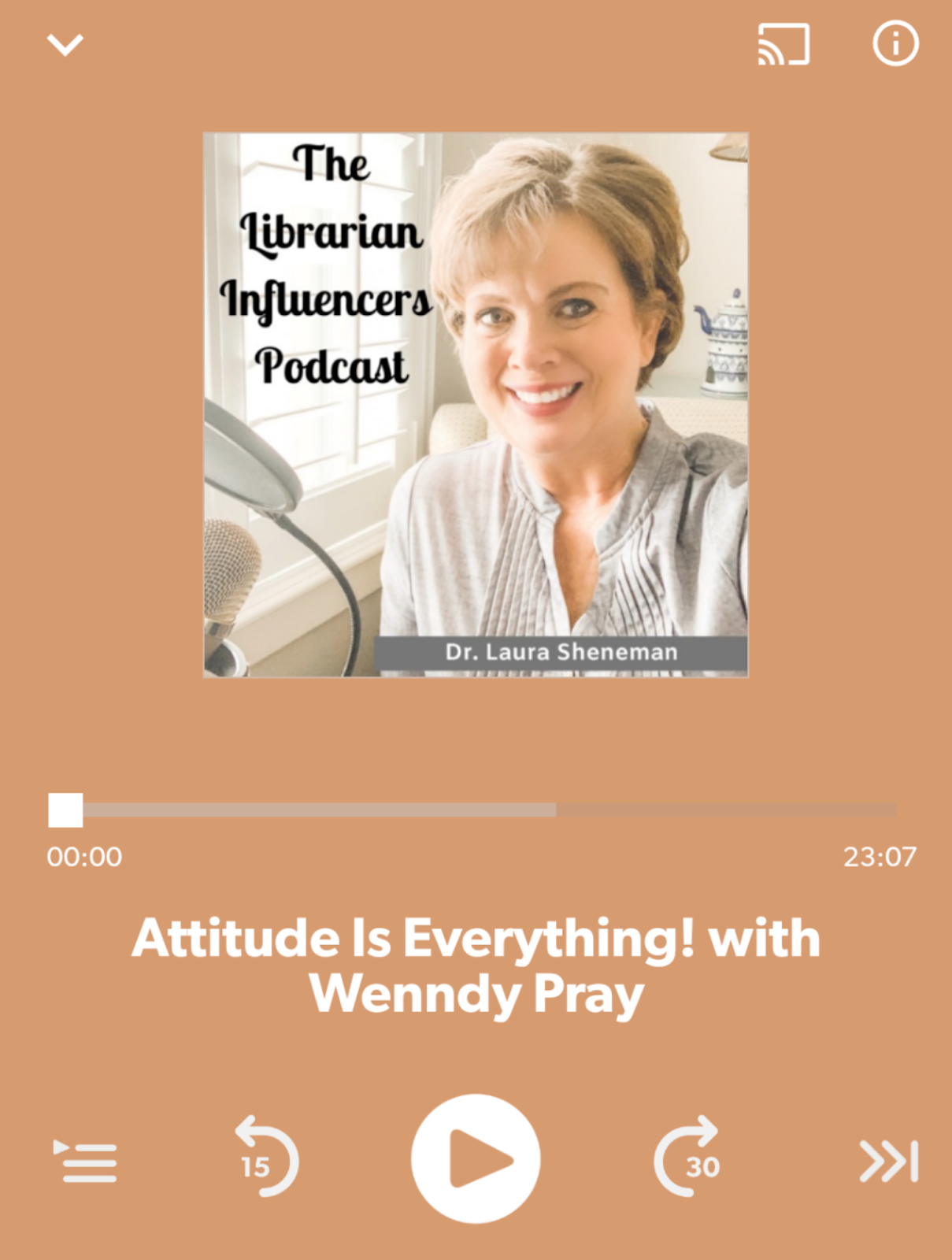
Lucky for me, our district librarian has always been very helpful in providing opportunities to expand our horizons, and after writing "Reflections of a First-Year Librarian" for the Texas Library Journal, I realized that I could contribute my experiences to my community and help my fellow librarians establish a strong start in their career. Shortly after I wrote this article, I read Brave Before Perfect: A New Approach for Future Ready Librarians by Traci Chun. That, along with further encouragement from my peers, provided the impulse I needed to answer an invitation that Dr. Laura Sheneman, Coordinator of Library Services and Information Resources for Region One Education Service Center, had extended to experts in the field. It was an invitation to propose topics for her new Librarian Influencers podcast. So I was brave.

Filling out the proposal was a piece of cake. I’ve always inspired my students to write about what they know, so I would do just that. I wanted to share about my successful start in the library. I was to begin my fourth year and was confident that I could share my experiences and advice over a new platform: podcasts. Frankly, it was exciting. Whether I’d be approved or not, just filling out the proposal and stepping out of my comfort zone made me happy. 

The turnaround was quick. Dr. Sheneman sent an approved message with detailed instructions on how to arrange what we would discuss. This made me feel confident and secure. I need structure, so preparing notes before our recording helped me keep my discussion and answers on topic. When I get excited about something, I tend to talk about other related topics, so this was incredibly helpful. She presented it in a form of a Google Slide. I selected a quote that summarized my vision and thoughts about librarianship and provided a picture for the podcast promo.


And now for the play-by-play. I introduced myself, shared about my school and student body, talked about the wonderful faculty on my campus, and expanded on the relationship I have with my school’s administration. I shared on my professional learning network (PLN), important books that keep me grounded and focused, and about how attitude is everything. I even expanded on what I would tell myself at the start of my career. (Wouldn’t we all just love a time machine?) It was a wonderful experience to share and enrich my librarian community. And although I had prepared some notes to help me answer the questions, I felt relaxed with the organic experience. And the best part is that I was chosen to be the inaugural speaker to kick off the podcast! Being the first guest speaker was indeed a special treat. (Thank you, Dr. Sheneman!)

I know I have peers whose minds are riddled with the same thoughts of not knowing what to contribute - especially those of us who have fewer than five years in the field. But you do. We do! We all have something we can share to grow, broaden our perspective, provide encouragement, or just confirm the path we’ve taken. We all do great things and can be called experts in something we do well for our students and library program. I encourage my fellow librarians to reach out. 

You can tune in to The Librarian Influencers podcast on iTunes, Stitcher, Google Play, and Spotify. I am one of many librarians who have provided their insight on various issues in librarianship. “It’s a time to share your professional voice. It’s a time to offer other librarians a chance to build their PLN. Especially for those who are alone in their district or area. It’s a time to connect and be empowered,” shares Dr. Sheneman.


I felt just that. Was it perfect? Not by any means. But being brave enough to step out into uncharted territory has sent ripples of support into my librarian community. This experience has also given me the confidence to share through the TASL Lunch & Learn platform with short webinars. Imagine what we could all do for our fellow librarians. I encourage you to step out, search within you, your style, activities, ideas, outreach - let’s be brave for each other. Because we all have something to share.


Teacher Day @ TLA - Teachers + Librarians = Dynamic Duos!

By Jennifer Eckert, Library Specialist in Northside ISD, San Antonio


Collaboration with teachers is a large part of any school librarian’s job. We are always looking for ways to inspire and encourage collaboration in order to meet all our students’ needs. Let that inspiration come from facilitating an experience at the Texas Library Association's 2020 Annual Conference!

The TLA Annual Conference – made up of books, authors, technology integration, makerspaces, curriculum connections, and supportive librarians – is the stuff of teachers’ dreams. Connect with your teachers, encourage their innovation, inspire them to greater collaboration, and impact their instruction by inviting your teachers to join you at this year’s Teacher Day @ TLA!

Teacher Day @ TLA, which will take place on Thursday, March 26, 2020, provides classroom teachers with the opportunity to experience a special one-day event during the TLA conference comprised of speakers, activities, and pricing designed just for them.

This is your chance to inspire your teachers and form a dynamic duo! You, as a sponsoring school librarian, will play a crucial role by identifying interested teachers, helping them secure permission and funding for their attendance, guiding them through the registration process, and ensuring our guest teachers have a positive experience.

The planning has begun for a fun, interactive day for the teachers who attend, as well as the librarians who sponsor them. Participants are welcome to stay for the full conference. Now is the time for interested librarians to:

a) identify motivated classroom teachers and

b) start to lay the groundwork for conference attendance and travel funding.

The focus of this program is for classroom teachers who experience a TLA conference to return to their districts as library advocates and collaborators - or perhaps become librarians themselves. Details and application information about Teacher Day @ TLA, an event that has become an annual highlight, can be found at http://www.txla.org/teacher-day. You can also follow us on social media for updates using the hashtag #TDTLA. Don’t miss this opportunity to increase collaboration on your campus!

#txlchat, or Yes, Virginia, you really should be using Twitter for professional development

by Kristi Starr, librarian at Coronado High School in Lubbock ISD, TxASL Chair-Elect


August and September always bring lots of excitement and renewed energy. It’s a time of new beginnings and reboots. With September comes a new season of #txlchat - a weekly 30-minute Twitter chat each Tuesday evening at 8:00PM Central. Each week you will find a topic of discussion applicable to librarians and library settings. You can lurk (observe) or contribute as much as you’d like. From seasoned veterans to first-year librarians to those still completing certification, all are welcome!

#txlchat, like most Twitter chats, follows a Q&A format. Questions will appear every 5 or so minutes, noted by Q and the question number. Responses should be preceded with A and the question number. Each response should contain the hashtag #txlchat For a more in-depth guide to engaging in #txlchat, check out this document if you plan to follow from a mobile device or this guide for participating on a Chromebook, laptop, or desktop.

We know that it’s difficult to set aside time every week for a chat. Family takes priority, work can get in the way, and sometimes we just plain forget. That’s why each chat is archived using Wakelet. Sharon Gullett sends out the archive Tuesday night or Wednesday morning via the TLC listserv. You can also access all the archives at http://txlchat.weebly.com/archives.html Want a reminder 30 minutes before each chat? Sign up to receive messages via Remind. You may also preview the topics and questions for the week prior to the chat. If you want to share ideas but know you won’t be available, use a site like Twuffer to schedule your tweets.


#txlchat has been one of the best, most consistent learning platforms I’ve encountered. The weekly chats have allowed me to expand my professional learning network (PLN) through contact with other librarians across the state and country. For 30 minutes each week, we come together - learners and sharers from disparate locations and time zones, each seeking ways to improve our practices, to engage and impact our communities.

Topics for September include

September 3 - Welcome Back with the Power of TexQuest
September 10 - Falling into Programming
September 17 - Libraries Transform
September 24 - I Can’t Live Without ...

Join the #txlchat team tonight for a fast-paced half hour of learning. You’ll be glad you did!

Lunch & Learn Webinars

by Brandi Rosales-Dawson, Library Systems Administrator in Richardson ISD, and Stacy Cameron, Coordinator of Library Services in Frisco ISD


The Texas Association of School Librarians (TASL) Lunch & Learn webinars are back for another year with timely topics including scheduling, collaboration, communication, programming, and more. The webinars began last year after the TASL executive board saw a need for additional professional learning specifically for Texas school librarians, since not all school librarians are able to attend the annual TxLA conference. Through the support of former TLA Executive Director Dana Braccia, TASL Lunch & Learn webinars were created in a weekend and launched in December of 2018. 

We knew we wanted the series designed around Texas educators presenting the content for several reasons. First, we have amazing school librarians across this state doing great things on their campus, and we want to highlight and lift up their hard work so others can learn and implement those ideas. Second, presenters need to be accessible to those attending or watching the recording. While there is value in seeing national speakers present, we want an attendee to feel they could contact a presenter for additional tips and tricks as they move through their own implementation. Lastly, as we know school librarianship can make us feel like islands, and this is one way to help school librarians connect with each other across the state. 

During the initial year, presenters were selected by word of mouth and their online reputation for innovative implementations on their campus. The Lunch & Learn webinars were such a hit last year with the average registration for each webinar being about 80 and live attendees around 25. This year we opened it up to any Texas librarian/educator who wants to share library programming implementations or instructional practices they are doing on their campus and/or with their community. At this time we are still looking for presenters to fill weekly webinar offerings through the end of the year. If you have a great programming or lesson you would like to present, please fill out the following form so we can get you on the schedule. 

Webinars are free to all TASL members, but registration is required. Each webinar lasts only 30 minutes, but if you’re unable to attend live, you can access the recording once it has concluded. 

To register for a September webinar, click here

September 4 - Flexible Scheduling in the Elementary Library
September 11 - Library Ambassador Customer Service Program
September 18 - Upgrade Your Secondary School Library
September 25 - Level Up Your Staff Newsletter

For future webinars, keep an eye on your inbox for emails from TASL or you can find registration links on the Texas Library Association website!