TLA 2021: Celebrate Differences, Empower Voices

by Kristi Starr, TASL chair 2020-2021, librarian at Coronado High School, Lubbock ISD
 

The 2021 Texas Library Association conference is rapidly approaching, and I hope you’ve decided to attend. Though things look different from our usual beloved conference, we still have many opportunities to connect and interact. Thanks to an early decision on the part of the Programming Committee co-chairs, TLA executive board, and TLA staff, we've had ample time to plan a wonderful online conference. I can’t give enough props to ProCo co-chairs Valerie Prilop and Melanie Scales, TLA president Christina Gola, ProCo/TASL liaison Ann Vyoral, and of course the amazing staff at TLA for all their work. 

I’m excited about what you’re going to experience next week. We have a variety of sessions: live, simulive with live chat, simulive with live Q&A after, and on-demand. Live sessions offer exactly what their name implies. The simulive sessions are pre-recorded but provide either a live chat with the presenter(s) during the session or a live Q&A with the presenter(s) immediately following the recording. On-demand sessions may be viewed at any time. ALL sessions will be available to watch through June 22. 

If you’ve registered for the conference, look for an email on Monday, April 19, that contains your log-in credentials and provides more information about the conference and platform. If you have more questions, check out the conference FAQ page at any time. We invite you to follow along and contribute to online conversations using the Twitter hashtag #txla21 Also be sure to check out the conference schedule in the winter edition of the Texas Library Journal. 

TASL is featuring two speakers who are new to TLA - Michelle Easley and Julie Stivers.

https://www.michelleeasley.com/meet-michelle

Michelle is the founder of Positive Push Press, a publishing and consulting company. She is an experienced librarian and accomplished library leader both in Georgia and at the national level. I first heard Michelle when she served as a powerful voice on AASL past president Mary Keeling’s Task Force on Equity, Diversity, and Inclusion. We are fortunate to have her join us this year for two sessions - “Open Your Virtual Doors” (Friday, 1:45) and “Disrupt Inequity With Your School Library Program” (Friday, 4:00). Michelle is also the author of Increase Diversity in School Library Collections and Programs. Find out more about Michelle at https://www.michelleeasley.com/

https://www.libraryjournal.com/?detailStory
=julie-stivers-movers-shakers-2019-change-agents

Julie Stivers is the librarian at Mount Vernon Middle School in Raleigh, NC, part of the Wake County Public School System. Attending Julie's presentation at the 2019 AASL conference in Louisville, KY, was one of my highlights. Julie is a champion of inclusion and student voice and authored Include, one of six volumes in AASL’s Shared Foundation Series. She was named one of Library Journal’s 2019 Movers and Shakers. Julie’s TLA sessions are “Auditing Our School Library Space & Program With an Equity Lens” (Saturday, 10:15) and “Equity: Moving Beyond Intention to Inclusive Practice” (Thursday, 3:00). You can find Julie and her campus library program at https://mtvernonlibrary.weebly.com/

The other live TASL sessions are
  • “Advocate This, Not That” with Stacy Cameron, Brandi Dawson, and Emma McDonald (Thursday, 10:15)
  • “Letters About Literature: Student Engagement and Inclusion” with Rebekah Manley and Abby Harrison (Friday, 1:45)
Simulive sessions with live Q&A at the end of the presentations are
  • “LGBTQ+ Advocacy in the Library and in The Classroom” with Heather Hornor, Mahoganie Gaston, and Camille Stafford (Thursday, 1:45)
  • “Windows and Mirrors: Mexican American Literature for Youth with the Rivera Book Award” with David Bowles, Xelena Gonzalez, Dr. Sandra Murillo-Sutterby, and Priscilla Delgado (Thursday, 4:15)
  • Digital Playgrounds for MS and HS: Using Choice” with Claire Hogg and Angie Pidgeon (Friday, 10:15)
  • “Library 24/7/365: How to Promote Your Program to Families at Home” with Brooke Corso, Keris Christie-Law, Tracy Frey, Paige Miller (Saturday, 10:15)
  • “Science and Library Collaboration for a Curriculum-Aligned Makerspace” with D’Anne Mosby and Rhia Johnson (Saturday, 1:45)
We have many more familiar names and faces as well as some Texas school librarians presenting for the first time at TLA. Whether new or familiar, I’m quite confident you’re going to find amazing content. Additionally, you’ll have access to ALL conference content until June 22, so you won’t be limited in the number of sessions you can attend. Be sure to check out the TASL sessions, but don’t forget the Young Adult Round Table (YART) and Children’s Round Table (CRT) programming, Programming Committee sessions, and so many more.

I look forward to “seeing” you at #txla21 and face-to-face in 2022 in Fort Worth where we will embrace the aptly-worded theme “Recover, Rebalance, Reconnect.”



It's Not Just Books and Bonbons

 by Deborah Zeman, Coppell High School 

Clubhouse logo
https://ccnull.de/foto/meet-clubhouse-the-voice-only-social-media-app/1038705
Lizenz: CC-BY 2.0  Marco Verch


The last year of Covid has thrown a wrench into everything: everyday life, connecting, collaborating, you name it. As an edtech librarian, I’ve been searching for ways to collaborate more with librarians in the same boat as me: trying to build a collaborative partnership with teachers while in a remote setting. It hasn't been easy, until now. Over the past few months, I have been playing around with the Clubhouse app.

You might be thinking to yourself, “Oh great, another app to add to my already overloaded plate. What IS this thing called Clubhouse?" It is an audio-only social media platform where users can listen in to discussions or panels, start conversations, and network with other like-minded professionals.

At first when I joined, I was skeptical. Clubhouse reminded me of another audio platform that I wasn’t super set on. However, I decided to give Clubhouse a shot. After a couple of weeks of maneuvering around, making connections, listening in to panels, I discovered it was definitely a place to create a space for librarians, whether academic, public and school. For myself, I joined clubs that are all about books, such as What Are You Reading?, Diverse Shelves, Entrepreneurs on Etsy, and Education Innovation to name a few. I’ve joined chats over edtech, diverse books, young adult fiction, and even chats with Elon Musk and Ashton Kutcher. In some I have jumped up on stage and joined the discussion; during most, however, I just listen and learn. The sky is truly the limit on Clubhouse.

I made a lot of connections with other professionals in the edtech world, however, my search for fellow librarians was coming up empty. My original search came up with maybe fifteen other librarians but no librarian groups. As I became more frustrated I thought to myself, “Wait, why can’t I build a Librarians’ Clubhouse, one where librarians can discuss topics from advocacy to connecting with patrons, to favorite tech tools and books genres?” From there, with a little help from Twitter & Facebook, It’s Not Just Books & Bonbons librarians’ Clubhouse was born. (The idea for the name will come in a later post.)

First stop - Monica Burns’ blog. This helped a lot. Here are some of her best tips to get started on the app:
  • First, download the Clubhouse app to get on the waitlist or reach out to a friend for an invite. (NEED to have an iPhone. Android app is coming soon!)
  • Next, follow educators on the platform by searching for keywords related to your area of interest.
  • Then, listen in to rooms on different subjects to get a feel for how the app works.
  • Finally, check your notifications and set an intention for using the app.

These tips helped me find my way around the app and guided me with starting up a librarians’ Clubhouse. Monica started a clubhouse specifically for edtech tips. She offers weekly edtech tip chats on Mondays, 7pm EST & Thursdays, 7pm EST. I always discover some new tips that help with getting around on Clubhouse.

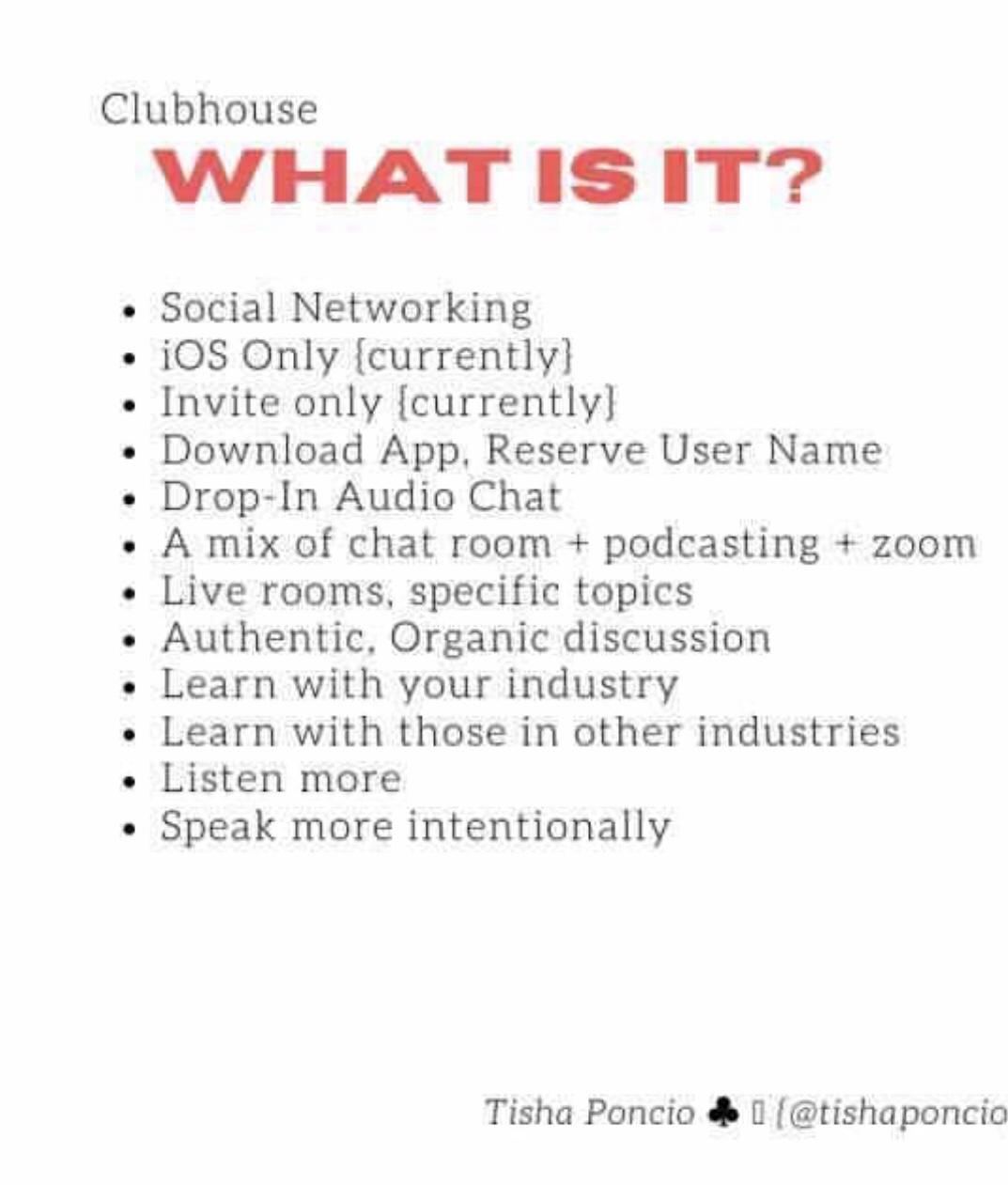
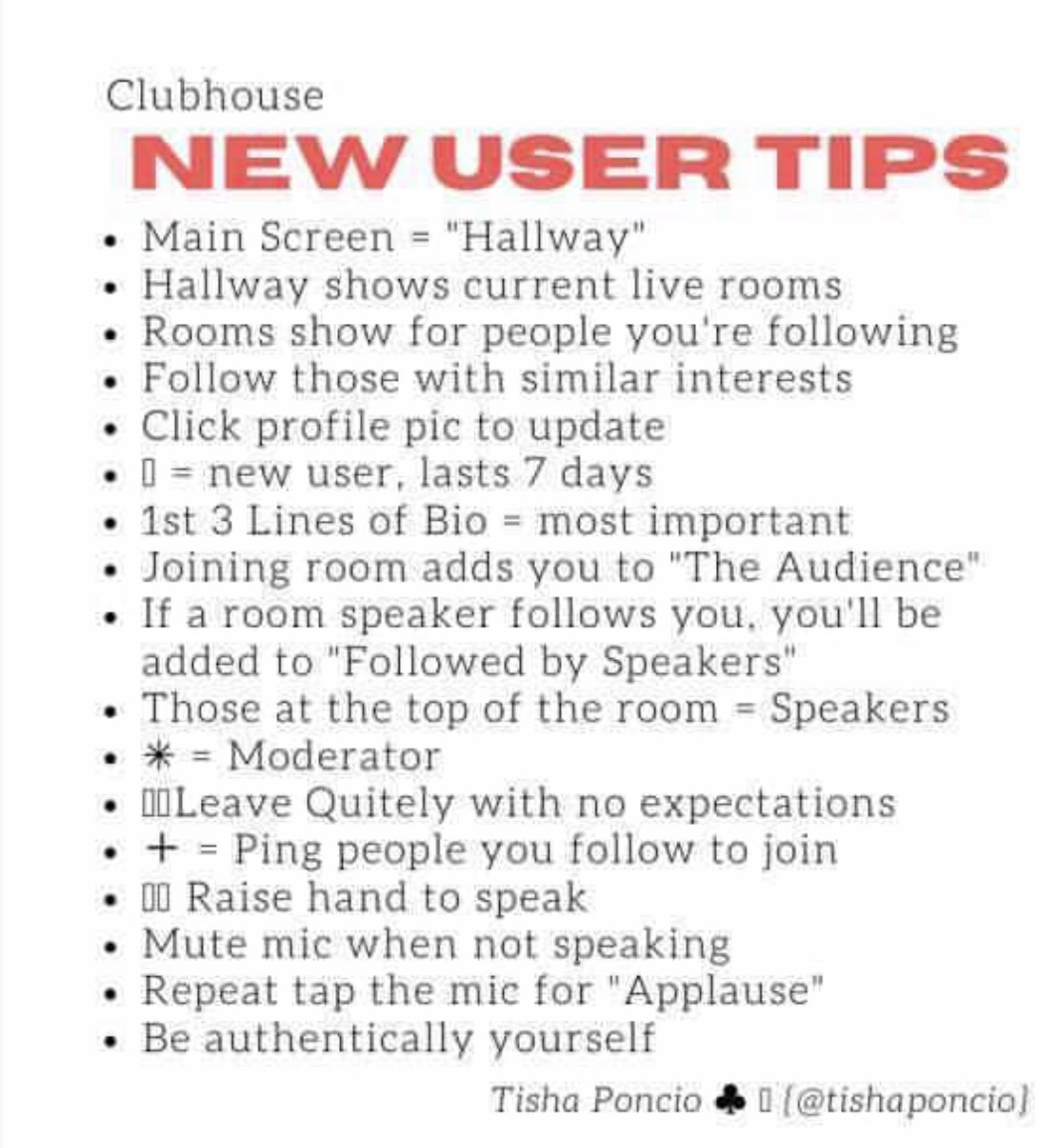
Tisha Poncio, my best friend and design guru, created some very helpful infographics to get started!


From there, as invites were added to my account, I started posting on Twitter & Future Ready Librarians’ group on Facebook. I invited fellow librarians who I knew would want to be a part of this growing community. My friends Amanda Hunt, Amy Hermon, & Heather Lamb moderate the rooms with me. The actual clubhouse was not yet approved, so to build momentum, we scheduled weekly chats on Wednesdays at 7:15 pm CST.

The first chat started out small, which was OK. We were new, not everyone was able to join. We were just getting our feet wet. We just got together to chat. Some people jumped in and stayed, some moved on, which is OK. There are no expectations. If people like what they hear, they will stay!

As the weeks have rolled on, and the It’s Not Just Books & Bonbons Clubhouse was approved, the group has grown. We have made connections with librarians from all over the world, including academic and public librarians. Each week we discuss collaboration, connecting with patrons and stakeholders, successes, and failures. And like Vegas, what happens in Clubhouse, stays in Clubhouse. If you want to learn more about the It’s Not Just Books & Bonbons Clubhouse, reach out to me on Twitter & I’ll send you an invite!

What is Project LIT All About? Two Secondary Librarians Share their Experiences

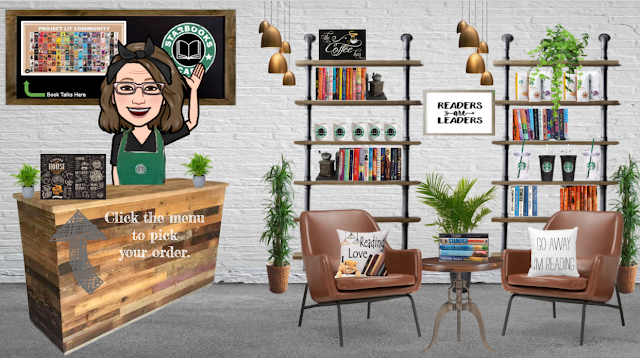
Project Lit Cafe Bitmoji Classroom

By Kara Johnson, Librarian at Hendrickson High School, and Kimberly LaMarre, librarian at Park Crest Middle School, both in Pflugerville

project lit booksnap
Project Lit Digital Incentive Wheel
Project Lit Booksnap


First of all, what is Project LIT? 

Kara: Project LIT began in 2016 when English teacher Jared Amato from Nashville, Tennessee, recognized that something had to be done about book deserts. He organized a huge book drive to distribute books to readers of all ages. He quickly realized though that the books needed to be high quality, relevant, and culturally sustaining. That is how Project LIT evolved into what it is today: a large network of Project LIT chapter leaders who commit to work together to empower readers, promote reading, and celebrate books. Each year Project LIT releases its list of book titles one by one through their social media accounts. There is a YA list and a middle grade list. One thing I learned is that you don’t have to be reading from the current year’s list. This is very helpful in implementing the program because there are dozens of titles from which to choose! And you can wait until books come out in paperback to help save money. 

How did you hear about Project LIT?
Kimberly: I’m at a middle school and I heard that the cool high school librarians were offering Project LIT...I wanted in for my students, too.
Kara: I first heard about Project LIT from Twitter. I started following their account and liked the titles on the lists. 

What made you decide to join Project LIT?
Kimberly: I’ve been booktalking our state reading list for years but when I saw the titles on the Project LIT list I was impressed that it was curated by students and reflective of today’s issues.  I wanted the conversation around books to be ignited--not just read and move on.
Kara: I decided to join Project LIT because the titles on the list are high interest, relevant, and inclusive. At the high school level it is hard to get students to want to read. I thought the PL books would help solve this problem. 


How are the books chosen?

Kimberly: Jared Amato’s students helped create the first list. Today, members of the Project LIT network from all over can submit nominations -- students, teachers, librarians etc. A giant list is compiled,narrowed down and sent back to the Project LIT chapters. They then submit their ballots on the books they are most excited about. Finally, the Project LIT educators meet to review votes and finalize the lists. Currently, my campus is reading the nominated lists and discussing.  We have not taken it to the level of finding a great title and sending in a nomination.
How does Project LIT benefit students and teachers?

Kimberly: Anytime you can get students to read, it’s a win.  If you can get them to discuss the books with others, then the learning is deeper and changes can be seen.
Kara: Agreed - It is hard to get high school students to like reading. If we can get the students to find at least one book that speaks to them we can possibly make a difference. The program also involves hosting events. I have shared live and taped interviews with PL authors with my ELA teachers. When the kids can actually hear from the authors, it helps them become more interested and connect in a deeper way to the books. 
Project Lit Novels for ELA

How have you implemented Project LIT during this strange and virtual year?
Kimberly: We launched Project LIT this school year, so providing the books for my in-person students and my virtual students was important. Diverse reading is my goal initiative this year. I had the financial support of my administrators as well, so we were able to purchase the titles in print and digital. We also added MP3 players of audiobooks and the digital audio as well. Many avenues to get these great titles read. Our campus uses Canvas, so I added Project LIT to our programs area. Students can link to book talks on the titles and then participate in silent discussions as they finish a title. Since we aren’t meeting in person, it was great to use the online platform to discuss. It also allowed my students to finish the titles at their own pace and add to the conversation when they were ready. I do have a special display for Project LIT titles right now but I also will keep the titles shelved in the regular fiction genres. To kick off the program we had gift cards from local places donated and when students participate in a silent discussion for a title, their name goes in a drawing for the gift card. It’s been fun to make the videos and spin the wheel of prizes.
Kara: HHS is implementing PL in the ELA classrooms. I received a $5000 grant at the end of last year to purchase ebook copies of the PL titles since we knew this year was going to be a challenge with print books. I originally was going to run virtual PL book clubs with our reading class, which is a class for struggling readers. The program quickly evolved though when our ELA teachers were able to acquire new novels for their classrooms through a textbook adoption. 9th, 10th, and 12th all chose titles that were on PL lists. I knew then that I would be helping them implement the PL within their ELA program. I switched my focus from small reading groups to purchasing large numbers of titles that the teachers were reading in their classrooms so that the virtual learners had digital access to the books as well. The ELA department purchased the print copies from their budget. It has been a partnership with the English teachers from the beginning of the year. I have shared resources with them for the titles they are reading and have shared interviews and poetry readings from the authors as well. I hope the program expands more next year to 11th grade. Since I was awarded a grant, I did a pre PL survey and will do a post PL survey about whether or not the students like to read and what their favorite book was that they read in English class. I have a feeling a lot of the PL titles will be the favorite of this year. Stay tuned….

How could it be implemented in a typical year?

Kimberly: I would continue what we have set up even if we were all in person.  The online format allows my students to read the words and thoughts of other students to help them select their next book.  It allows them to read at their own pace and not keep on a schedule with a group.  And it also allows my younger and older students to discuss all together instead of divided out by their grade level.  Since I don’t see my students in large classes I am doing most of the book talking through Google slide decks.  Each title has its own cover pic and then includes links to book talks by me, YouTube book trailers, author interviews and other fun media I can find.
Kara: Since we have used the program in the ELA classroom, I see it continuing for many years. My hope is that when we can gather again, we can hold in person meetings or events related to the books each grade level is reading. Maybe we could even get one of the authors to visit our school--fingers crossed! Virtual visits have not panned out this year but it is not due to a lack of trying.

How can librarians be a part of Project LIT?

Kimberly: Follow Project LIT on Instagram ( @projectlitcomm ) and Twitter ( @ProjectLITComm ) first; watch the posts and you’ll get how they disperse information.  You then can apply to lead a chapter at your school.  It’s all about reading and getting conversations started.
Kara: I second what Kimberly said!