So You Want to Join a TLA Reading List Committee? 10 Things to Know

By Priscilla K. Delgado, PhD Student at St. John’s University, TLA Reading List Coordinating Committee Co-Chair, TxASL Talks Member
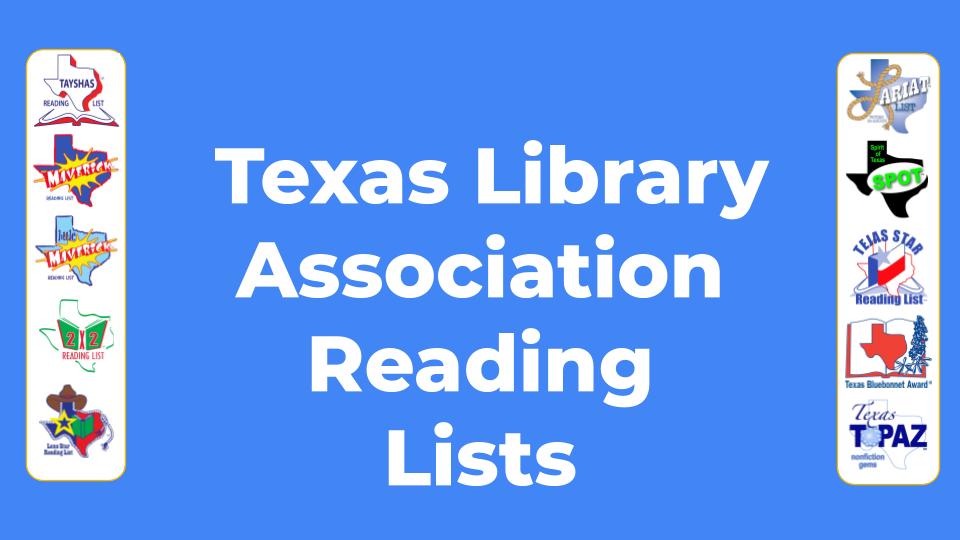

The Texas Library Association has ten reading lists for readers ages 2 to 102 ranging from fiction to non-fiction, Spanish titles, and graphic novels. These lists are determined by dedicated TLA members who are selected to serve on a reading list committee. It’s like a special book club!

How does someone go about applying and serving on a reading list committee? Here’s everything you need to know: 

  1. The TLA reading lists are under 3 umbrellas: 

    • Children’s Round Table (CRT)

      • 2x2

      • Little Maverick

      • Bluebonnet (jointly sponsored with TASL) 

    • Young Adult Round Table (YART)

      • Lone Star Reading List

      • Spirit of Texas

      • TAYSHAS

      • Maverick

    • TLA

      • Tejas Star

      • Topaz

      • Lariat

  2. Each umbrella group and Bluebonnet has its own application with its own deadlines. 

  3. Some reading list committees have prerequisites. For example, some committees require that you be actively providing library services to children for the duration of your appointment. Tejas Star requires members to be able to read in Spanish. Check each reading list’s website for details.

  4. The respective group leader(s) will review the applications and make appointments, usually in the fall. Notification and finalization of committees usually happen in January. Terms for new committee members will begin at a time decided on by the reading list chair and/or umbrella group leader.

  5. Terms are usually for 3 years. Meetings are typically held in-person and/or online at Annual Assembly and throughout the year. Reading list committee members usually do at least one program at Annual Conference, presenting content related to their latest reading list.

  1. Serving on a reading list calls for A LOT of reading! Publishers often send books to committee members to review. It’s helpful to have a designated space to keep all your books and to set aside time to prioritize reading. (Note: sometimes publishers aren’t always able to send books, which may require members to seek out the books themselves.)

  2. Communication is key! Committee members should have a reliable email address, check it daily, and participate in the function of the committee. It’s a lot of fun but also a lot of work.

  3. Each reading list committee has a chair and either an administrative assistant or vice-chair. The chair is responsible for setting up meetings, communicating with committee members and with their umbrella group leaders, and to facilitate all business matters pertaining to the committee. The administrative assistant/vice-chair usually is the point of contact for publishers. 

  4. In addition to reading, reading list committee members often create content for activity guides and reproducible materials, social media posts, and other projects to promote the reading list.

  5. Being appointed to a reading list committee can be a competitive, selective process. If you are accepted, woohooo!! If you don’t get accepted, please consider applying again the following year!

Still have questions? Feel free to get in touch with the respective reading list committee chair or with the Reading List Coordinating Committee co-chairs, Kate DiPronio and me at rlcc@members.txla.org. We will be happy to help in any way that we can. 


Good luck and happy reading!


Coping, Healing, & Persevering: Social-Emotional Learning with Technology

by Wenndy Pray, MLS - B. L. Gray Jr. High Librarian, Sharyland Independent School District


Humans are social creatures. Although some may argue that we can survive in solitude, we thrive on emotional connection, relationships, and company. As Viktor Maslov, Jean Piaget, and the many others who have expanded on their findings regarding social and cognitive development, librarians now find themselves at the forefront of discovery. Most importantly, we’re equipped with 21st Century tools that can help preserve this critical component for our students’ social and emotional development.
The current pandemic has placed limitations on an integral part of our experience on this earth: our social lives. This concern fills our minds and hearts with questions. How will our students survive this? How will our secondary students expand their interpersonal skills? How will our middle grade and elementary students learn what meaningful interaction looks like when they can only do it through a screen? How will our littles experience social-emotional growth at such an impressionable age? It would be comforting to have the answers to these questions. Humans are resilient creatures. We are overcomers. I can tell you that our students can. And they will. As their librarians, we are part of what will help them use this experience for good.
Librarians know the importance of telling our stories. Not only can reading, telling, or listening to a story inspire empathy, it can also be cathartic. Wakelet and Flipgrid are two web tools that can provide a safe, secure, and creative outlet for students. Students can learn about digital etiquette, or netiquette, connect through responding or collaborating, and by providing a place to tell their story.
If you haven’t heard about Wakelet, today is your lucky day. This visually-appealing, collaboration-infused, digital organizing tool is a platform where students can learn to create collections by uploading links to their favorite sites, type text, import tweets and YouTube videos, and even record live shorts using the Flipgrid integration. Students can use Wakelet to chronicle their experience distancing during the pandemic. This opportunity inspires creativity as well as supplies an outlet. It’s privacy options provide a safe environment for students to express themselves, share what interests them, or remember a loved one they’ve lost during the pandemic. 
Librarians can use Wakelet to showcase their latest programming, create newsletters for community outreach, and connect with other librarians as well.  Here is a collection titled School Librarians to follow on Wakelet. Connect with librarians across the world. You can find collections they’ve created with additional resources for social-emotional learning too. Students are not the only ones yearning for connection and filled with thoughts of what will be. You too can use Wakelet to express what you’re going through, share your thoughts through a video journal, or keep an introspective chronicle of time during COVID-19. Personal or professional social and emotional learning are both important. The “Only Me” privacy setting can keep those insightful and personal collections of thoughts and musings for your eyes only.
Flipgrid has also pushed several upgrades that enhance the user experience. Privacy, among many other features, has confirmed that as we move into a learning space that will demand more digital interaction, we need to remain conscious of how vulnerable our students are during this time. Providing a safe place in the digital classroom is just as important as it is in the traditional one. The Power of Flipgrid for Social-Emotional Learning by Martha Bongiorno describes five ways you can create content in Flipgrid to support social-emotional learning and development. Librarians share a bond with our students that no other faculty or staff member shares. We are a blend of educator, counselor, confidant, and advisor. As librarians, we can seize the opportunity for digital relationship building.  If students don’t want to type about what they’re feeling and observing, they can share their stories with video recordings. You can create a grid and control its posting capabilities by keeping posts private at the student’s request. Students now have the option to only record audio. These upgrades provide more options for comfort with expression and creativity. As mentioned earlier, Wakelet has a Flipgrid integration with shorts that can record up to ten minutes. Sharing encouragement, saying hello, or reaching out by sharing your favorite memory can help strengthen our students’ hearts and minds.
Wakelet and Flipgrid offer flexibility to assess our students’ social and cognitive development outside of an “assessment” environment. They provide a human touch that perhaps a bell-to-bell instruction setting wouldn’t. They provide more than a multiple-choice test could. Using these fun, engaging avenues to connect and help our students find their social roles in life may prove to be more meaningful than one may think. Although much uncertainty still looms on the horizon, we can establish digital avenues that will equip our students with what they need to cope, heal, and persevere. 

Now We Need to Promote Libraries More Than Ever

by Brooke King, Librarian at Atascocita Middle School, Humble ISD, TASL Legislative & Advocacy

The "Let's Promote Libraries!" social media campaign is more important than ever this year as we show how librarians support learning no matter what the school environment looks like.

This social media campaign encourages school librarians to show off what happens in their school libraries to stakeholders. The campaign began with the TxASL Legislative & Advocacy Committee with the hopes of encouraging school librarians to promote themselves, their programs, and their instruction. TxASL is continuing the campaign this school year as we chart into librarianship like we have never seen before.

Each month’s topic is still framed as a question organized around the revised Texas Library Standards. It begins with, “Did you know that school libraries…,” followed by one of the standards. I’m certain the standards may look a little different this year in how they are approached, but that will just show how innovative librarians are.

We will still tweet on the 1st of each month, and I will try my best to remember to tweet reminders! You can post on any social media outlet or even send an email to a stakeholder. We want to focus on local stakeholders first, and then at the state and national levels. This year is also important because we are approaching a legislative year in our state in 2021. We always want to be as proactive as possible.

Please use #TxASLTalks so it is easy for all of us school librarians to find and help share our messages. Then use #Txlege to share our message of the important role school libraries have with students and learning with our state legislators.


It’s easy to participate!

Step 1: Look at the current month’s question.

Step 2: Snap a photo and write your message showing how your library shows that standard.

Step 3: Post your message and photo on any/all platforms of social media.

Step 4: Be sure to use the hashtags #TxASLTalks and #Txlege along with other key hashtags.

Step 5: Repost/retweet/share


There are two infographics to guide you. One explains the full campaign. The other shows only the monthly topics.

Thank you for participating in this campaign and advocating for the work librarians do that contributes to the success of students and schools!